Competitor Mapping Research for Strategic Business Growth
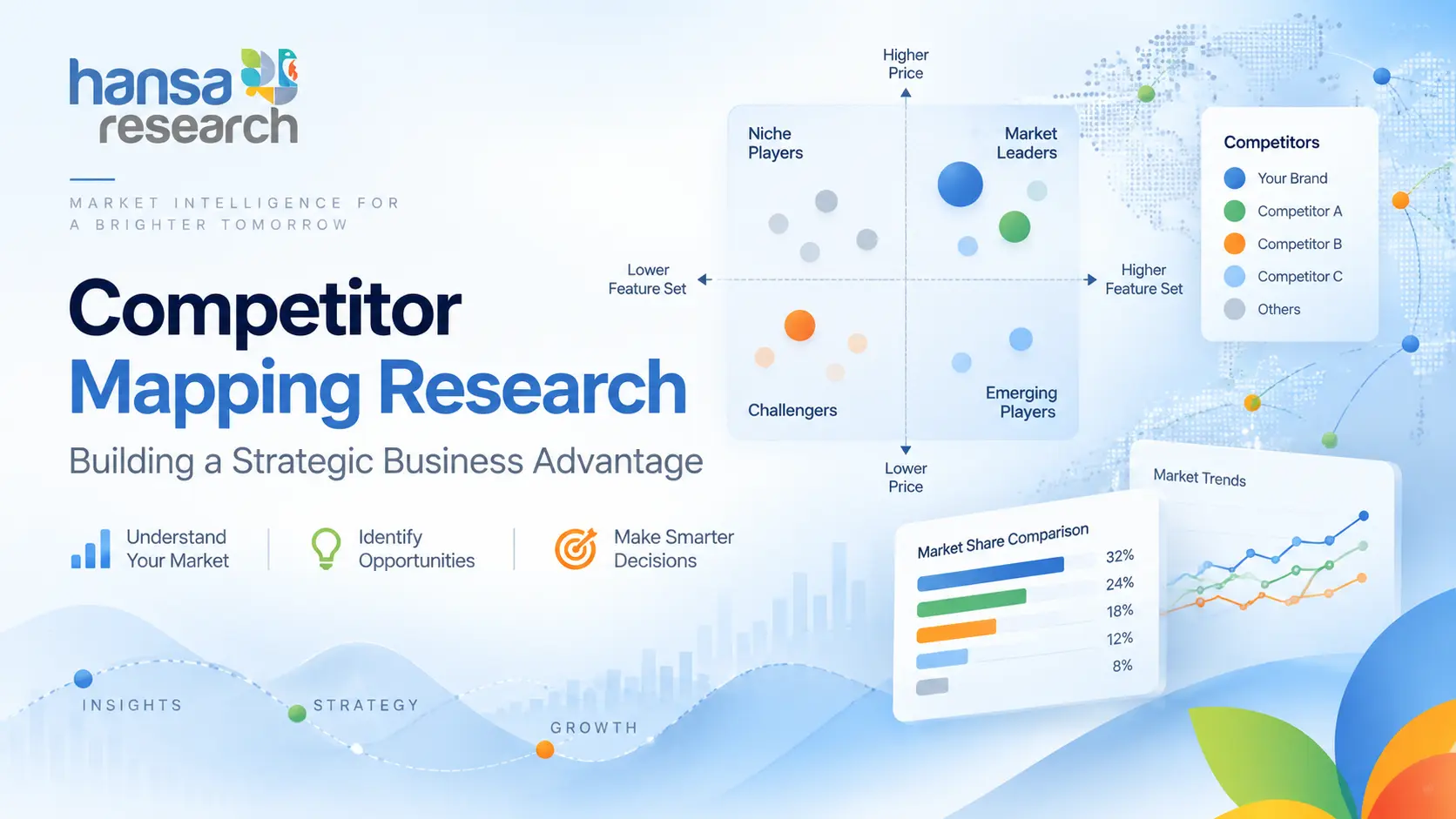
As markets move quickly with respect to customer expectations, pricing, technology, digital channels, and new entrants that can reshape the competitive landscape. Businesses relying on instinct or outdated information can miss important shifts.
So competitor mapping research provides a structured view of the market. It shows how competitors are positioned, what customers value, where opportunities exist, and which threats may be emerging. This supports stronger decisions around market entry, pricing, product launches, brand positioning, and long-term growth. That’s why with this blog we have tried to make it clear for you how indepth understanding on competitor mapping research.
What Is Competitor Mapping Research?
Competitor mapping research identifies, categorizes, evaluates, and compares competitors across important business parameters. Unlike traditional competitor analysis, which often studies companies individually, competitor mapping looks at the wider competitive ecosystem.
It helps answer questions such as:
- Where does each competitor position itself?
- Which customer segments do they target?
- How do they differentiate their products or services?
- Where are the strongest market opportunities?
- Which competitive threats are emerging?
Competitor Mapping vs Competitor Analysis
| Competitor Analysis | Competitor Mapping |
| Focuses on individual competitors | Evaluates the complete competitive landscape |
| Often supports tactical decisions | Supports long-term strategic planning |
| Reviews strengths and weaknesses | Highlights positioning, opportunities, and market gaps |
| Often reflects one point in time | Supports ongoing strategic monitoring |
Why Competitor Mapping Matters
Competition now comes from established rivals, startups, digital-first players, substitute products, and changing technologies. Structured competitor mapping helps businesses make decisions based on evidence rather than assumptions.
Identify market opportunities: Spot underserved segments, unmet needs, product gaps, geographic opportunities, and emerging trends.
Improve market positioning: Understand how competitors communicate value and sharpen your own positioning.
Strengthen pricing decisions: Compare pricing structures, value propositions, promotions, and customer perceptions.
Support innovation: Identify gaps and opportunities for new products or services.
Reduce business risk: Make expansion, investment, acquisition, and launch decisions with a clearer market view.
What Should Competitor Mapping Research Include?
A useful competitor map goes beyond basic company facts. It connects multiple dimensions so patterns, opportunities, and risks become easier to identify.
| Research Area | Business Insight |
| Company and market presence | Size, ownership, geographic reach, and market position |
| Products and pricing | Portfolio breadth, innovation, lifecycle, and pricing approach |
| Customers and positioning | Target segments, buyer profiles, value proposition, and messaging |
| Distribution and marketing | Online/offline channels, partners, campaigns, and promotions |
| Digital presence | Website performance, SEO visibility, social media, reviews, and reputation |
| Innovation and partnerships | New launches, R&D, alliances, acquisitions, and collaborations |
| Performance and SWOT | Growth trends, strengths, weaknesses, opportunities, and threats |
Core Competitor Mapping Frameworks
Competitive Positioning Matrix: Maps competitors across variables such as price versus quality or innovation versus market reach to reveal crowded segments and market whitespace.
SWOT Analysis: Compares strengths, weaknesses, opportunities, and threats across competitors.
Strategic Group Mapping: Groups competitors by traits such as pricing, distribution, product quality, customer segment, geographic reach, or business model.
Porter’s Five Forces: Adds an industry-level view by considering rivalry, new entrants, buyer power, supplier power, and substitutes.
A Practical Competitor Mapping Research Process
1. Define the objective: Clarify whether the research supports market entry, product launch, pricing, brand repositioning, benchmarking, or investment decisions.
2. Map the competitive landscape: Include direct, indirect, emerging, and substitute competitors.
3. Set the research framework: Define research questions, evaluation criteria, KPIs, customer groups, market segments, geography, and competitive parameters.
4. Collect reliable data: Combine primary research such as interviews, surveys, retail audits, or mystery shopping with secondary sources such as annual reports, company websites, industry publications, government reports, and financial information.
5. Benchmark competitors: Compare portfolio, pricing, satisfaction, innovation, market share, distribution, digital visibility, and engagement using consistent measures.
6. Visualize the findings: Use positioning maps, competitor matrices, heat maps, scorecards, SWOT dashboards, or opportunity matrices.
7. Turn findings into action: Translate research into recommendations on investment priorities, high-potential segments, pricing, competitor monitoring, and strategic actions.
Digital Competitor Mapping
A complete competitive view should include digital channels. Digital competitor mapping reviews website performance, organic search, SEO rankings, paid advertising, content, social media, reviews, online reputation, share of voice, and digital customer experience.
Companies with similar products may compete very differently online. Understanding these differences shows how competitors build visibility and acquire customers.
Hansa Research also applies competitive context in its Ad Impact Measurement service, which benchmarks advertising recall and impact across digital video environments. Its Category Deep Dive feature compares a brand’s results with others in the same category.
Where Competitor Mapping Is Most Useful
FMCG: Portfolio, pricing, retail visibility, distribution, and consumer preferences.
Retail: Store formats, omnichannel experience, promotions, loyalty programs, and expansion readiness.
BFSI: Digital capability, customer experience, innovation, service quality, and fintech competition.
Healthcare: Service offerings, patient satisfaction, provider networks, technology adoption, and regional infrastructure.
Manufacturing: Production capability, supply chain efficiency, technology adoption, distribution, and operational performance.
B2B markets: Account penetration, specialization, sales strategy, channel partnerships, and positioning.
Common Mistakes to Avoid
- Focusing only on price and ignoring customer value
- Tracking only direct competitors
- Using outdated information
- Making assumptions without validating data
- Collecting data without strategic analysis
- Treating competitor mapping as a one-time exercise
Competitor intelligence is most useful when reviewed regularly and refreshed after major market or business changes.
Why Choose Hansa Research for Competitor Mapping Research?
Strong competitor mapping requires more than collecting data. It requires interpreting market dynamics and turning evidence into recommendations that support business decisions.
Founded in 1983, Hansa Research brings decades of market research experience and analytical methodology. Its work includes industry benchmark studies in India such as the Indian Readership Survey, Household Potential Index, and Indian Outdoor Survey, along with newer offerings such as Ad Impact Measurement for digital video.
Our competitor mapping approach combines primary research, secondary research, analytics, and sector expertise to help businesses:
- Build a clear view of the competitive landscape
- Identify emerging market opportunities
- Benchmark against industry leaders
- Understand customer perceptions and buying behaviour
- Evaluate pricing and positioning
- Track evolving market trends
- Build growth-oriented strategies
Whether a business is entering a new market, launching a product, reviewing pricing, or strengthening its long-term position, the aim is to provide reliable competitive intelligence for faster, more confident decisions.
Frequently Asked Questions
What is competitor mapping research?
It is a structured analysis of competitors across factors such as positioning, pricing, target markets, products, marketing channels, digital presence, and market performance.
How is competitor mapping different from competitor analysis?
Competitor analysis usually focuses on individual companies. Competitor mapping looks at the wider competitive ecosystem and how different players are positioned within it.
Why is competitor mapping important?
It supports evidence-based decisions around market expansion, pricing, product development, brand positioning, customer acquisition, and long-term strategy.
Which industries benefit from competitor mapping?
It is useful across FMCG, retail, BFSI, healthcare, manufacturing, technology, telecommunications, and B2B services.
How often should competitor mapping be updated?
It should be reviewed regularly and refreshed when there is a major market shift, competitive change, or important business decision.
Conclusion
Competitor mapping research gives businesses an evidence-based way to understand the market, benchmark competitors, identify opportunities, and reduce risk. Hansa Research helps organizations move beyond basic competitor analysis with research built around specific business objectives, giving teams practical intelligence for clearer decisions on positioning, pricing, innovation, and growth.


